

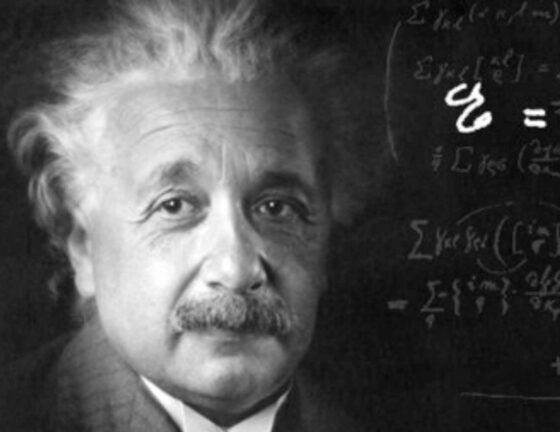
….says to keep your balance, you have to keep moving”
Albert Einstein, a scientist, speaking to his son in 1900: “Life is like riding a bicycle: to keep your balance, you have to keep moving
It’s one of the most shared pieces of advice online. “Life is like riding a bicycle. To keep your balance, you must keep moving.” It turns up on posters, classroom walls, and social feeds.
But this line did not start as a clean slogan for strangers. It traces back to a personal letter Albert Einstein wrote in 1930, and the original wording is a little different in ways that change the message.
A line from a letter, not a speech
A 2021 peer-reviewed paper by Marie Bassford, published by De Montfort University Press, points to a 1930 letter he wrote to Eduard Einstein. It quotes the German line “Beim Menschen ist es wie beim Velo. Nur wenn er faehrt, kann er bequem die Balance halten,” and notes that translations vary, including a literal version that begins with “People are like bicycles.”
That matters because it frames the line as practical advice, not a scientific claim. The version most people know swaps “people” for “life,” and it smooths the language into something that reads like a slogan.
Why a bicycle is a smart metaphor
Ever tried to balance on a bike at a standstill at a stop sign? The slower you go, the more you wobble, and you end up putting a foot down.
In practical terms, staying upright is not about being perfectly still. It is about tiny, constant corrections with your body and the handlebars, so the wheels keep rolling instead of tipping over.
That is why the metaphor lands with so many people. It suggests that balance comes from motion and adjustment, not from freezing in place and hoping nothing changes.
Albert Einstein with a bicycle, representing his famous quote about balance and the need to keep moving
Einstein’s bicycle metaphor, drawn from a 1930 letter, continues to resonate as a lesson in resilience and steady progress.
“Keep moving” does not mean “go faster”
Here is the part people sometimes miss. Moving can be slow, careful, and even awkward, the way it feels when you are learning to ride with shaky turns and sudden stops.
Writer Blanca del Río highlights that the image pushes back on the fantasy of a stable life with zero bumps. The point is not to avoid hills and curves, but to keep pedaling through them, even if the pace is modest.
What counts as “moving” when you feel stuck? Sometimes it is one small step that nudges you forward, not a dramatic leap, and that can be enough to steady the ride.
Resilience is the modern word for it
In public health, “resilience” is often described as the ability to bounce back after a difficult or life-changing event, like a serious diagnosis or a natural disaster. The Centers for Disease Control and Prevention also notes that people tend to do better when they build habits that help them withstand, adapt to, and recover from hard moments.
Research on resilience is not just about rare extremes. A 2016 review hosted on CDC Stacks reports that up to about 84 percent of people will experience at least one potentially traumatic event, and it notes that many do not develop long-term mental health disorders afterward.
Small edits can also shift the meaning. “People are like bicycles” is oddly direct, while “life is like riding a bicycle” turns it into a general rule about existence, and those are not the same thing.
So if the line ever feels too perfect, that may be why. What started as a private note can end up as a public message polished by repetition.
Digital archives changed what we can check
One reason the original context is easier to talk about now is access. A 2012 announcement said a complete catalog of about 80,000 documents written by or addressed to Einstein was made available online by the Hebrew University of Jerusalem and the Einstein Papers Project at the California Institute of Technology, with scholars adding annotations and translations for some records.
In day-to-day terms, “keep moving” might look like sending the job application, showing up to practice, or finally handling that overdue task that has been hanging over you like an unpaid bill. Not dramatic, just forward.
And yes, there is risk, like any bike ride. But the deeper promise is simple. Balance is built in motion, one correction at a time.
The main official edition of the letter has been published in The Collected Papers of Albert Einstein