

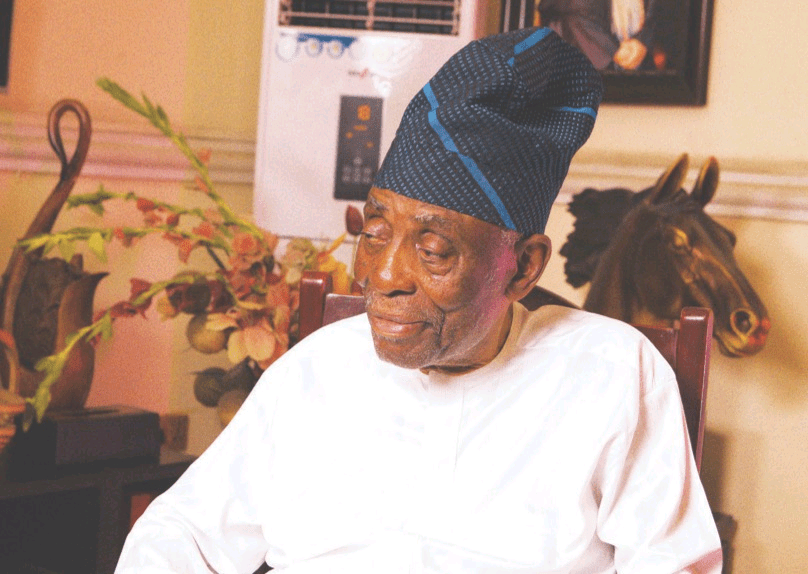
How friendship with Fela, Jakande, Oguntade, others shaped my life –Pa Alebiosu, Lagos GAC leader
•Why I married my wife without her parents’ consent
•Things I keep thanking God for at 90
Few personalities embody the intersection of culture, politics, enterprise and enduring relationships like Otunba Busura Adedeji Alebiosu.
At 90, his life story is not only a chronicle of personal resilience and achievement but also a window into decades of Nigeria’s socio-political evolution, told through the lens of the remarkable figures he has walked alongside.
From the bustling streets of London in the early 1960s to the corridors of political power in Lagos, Alebiosu’s story is deeply intertwined with some of Nigeria’s most iconic personalities.
Long before he became a political force, Alebiosu shared a formative friendship with Afrobeat legend, Fela Anikulapo-Kuti.
Both young men navigating life in London, their bond would leave a lasting imprint. Most notably is the nickname that has followed Alebiosu for decades.
“In 1961, we were in East London with some South Africans,” he recalls. “They couldn’t pronounce ‘Busura.’ Fela simply said, ‘Call him Bush.’ That was how the name stuck.”
In those days, he says, their friendship was inseparable: “Whenever you saw Fela, you saw Bush.”
In this interview, Alebiosu, a member of Lagos State’s Governance Advisory Council (GAC) reflects on his relationships with Fela, the retired Supreme Court judge, George Adesola Oguntade, late governor of the state, Lateef Jakande, father of the current Deputy Governor, Alhaji Hamzat, President Bola Tinubu, among others and the defining moments that have shaped his extraordinary journey.
How were your growing-up days like?
I, Otunba Busura Adedeji Alebiosu, was born on April 24, 1936. I was born in Ijasi quarters, Ijebu-Ode. I attended Moslem School, Ijebu-Ode, thereafter came to Lagos and served as a gas station attendant around Denton, Ebute Metta, Lagos. From there, I went to the United Kingdom to study first at the Hammersmith College of Arts and Building and then proceeded to Paddington Technical College to study Welding Engineering.
After that, I worked briefly before returning to Nigeria with my bosom friend, Hon Justice George Adesola Oguntade, a former Supreme Court of Nigeria judge, who studied law at Holborn College, UK. It was after we got back to Nigeria that we set up our own companies.
What did you want to become in life while growing up?
I just wanted to better my life. I trained in Britain. I returned to Nigeria in 1967 and worked briefly with GMI Structural Engineering. Later, I worked with a technical company. After about seven years, my very good friend, Justice Oguntade and I established a company called LJ Engineering Nigeria Limited. I served as the Executive Director while he was the Chairman. We owned the company on a 50/50 basis.
Apart from Fela Anikulapo-Kuti and Justice Oguntade, who were some of the people you grew up with?
I grew up with people like the late Kanbi Ishola Osobu, Frank Okonta, Ikomi, and several others.
Tell us more about the company you formed with Justice Oguntade
Well, we eventually named the company Helios Engineering. I saved some money from where I worked, and Oguntade also saved some money and we both invested in the business. With my own engineering background and his own legal background and training, we decided to combine resources and form the company. Initially, we called it Skyline Metalworks, then changed the name to Helios Engineering. The business took off like a rocket, and we started making money. We were doing three shifts at the factory, morning, afternoon and evening. Our bankers were giving us credit facilities and when we required and expanded remarkably, honouring all our obligations and contracts, life was good. Our major clients were Leventis Group at Iddo House, Pera Beam, a division of UAC and others.
How did you come into politics?
I joined politics in 1976 with Chief Obafemi Awolowo in Somolu Local Government. At that time, Somolu had just been created out of Mushin Local Government.
What was your relationship with Alhaji Lateef Kayode Jakande, who later became Governor of Lagos State?
I won a local council election and later became a member of the Lagos State House of Assembly during the Jakande administration. I won elections in both the first and second terms. The late Jakande and I were very close. He was like a father to me.
After the termination of the second republic by the military, did you opt out of politics?
A few of us formed a group behind the scenes. The group included me, Chief Tajudeen Olusi, late Alhaji Hamzat, the father of the current deputy governor of Lagos State, the late Rasheed Shitta-Bey, and several others. We worked together politically, and it was through this network that we supported the emergence of Dapo Sarumi as a candidate for Governor of Lagos State.
Could that group have been Primose?
Yes, you are right. It was Primose. Chief Tajudeen Olusi was the chairman of Primose.
You and your friends, Chief Tajudeen Olusi and the late Alhaji Hamzat, became powerful forces in Lagos State politics. How did you do it?
Yes, we have been together for a very long time, since the Second Republic during the UPN days. Chief Tajudeen Olusi was a member of the House of Representatives then. The late Alhaji Hamzat served as a commissioner and also as a member of the Lagos State House of Assembly. That was where we met. Chief Tajudeen Olusi, whom we call the “Prince of Peace,” is from the Central Senatorial District; the late Alhaji Hamzat was from the West Senatorial District, while I am from the East Senatorial District.
You are also a member of the Governance Advisory Council (GAC) of Lagos State, a body that plays a leadership role in the state. Give us a clue on some of your activities there.
Our role is mainly advisory. We advise the governor.
President Bola Ahmed Tinubu has been your friend for about 40 years before becoming president. How would you describe your relationship with him now?
President Bola Ahmed Tinubu is very reliable. He is doing a good job, and I am proud of him.
You are the Otunba Gbelegbuwa of Ijebuland. When did you got the title?
That was in 1987. The late Awujale of Ijebuland, Oba Sikiru Adetona, invited me to his house and conferred the title on me. As the Awujale, he had the prerogative to give chieftaincy titles to anyone he considered deserving.
You must have been very close to the late Awujale before he decided to confer such a title on you?
Yes, we were very close. Kabiyesi, the late Awujale, was a highly principled man. His yes was yes, and his no was no.
Just recently, you were made the Chairman of the Council of Otunbas of Ijebuland. How have you been coping with such a demanding office?
I am not alone. I have Otunba Dr Hassan as the First Vice Chairman and Otunba Osiyemi as the Second Vice Chairman. With their support, I am coping very well.
What fond memories do you still have of the late Awujale?
Many memories. Kabiyesi, Oba Sikiru Adetona, was a highly principled man who did not tolerate nonsense. I miss him a lot. He was very reliable and a good man.
As a political leader, many politicians visit you to seek your blessings for their political ambitions. What do you tell them?
They must go through the normal democratic process. Candidates must emerge through primary elections at the ward and local government levels. I do not pick candidates and Tinubu does not pick candidates. It is the people themselves who choose their candidates.
At your age, you have seen a lot, particularly in politics. What advice would you give to politicians today?
If you want to succeed in politics, you must be hardworking. You cannot rely solely on having a godfather somewhere. You must work hard and campaign vigorously. If you do that, you may be fortunate enough to be chosen as a candidate. I understand politics very well; sometimes I even call myself the professor of politics.
At 90, what are the things you thank God for?
I thank God for giving me a good life, a good family, and good people around me
As a politician who is always moving from one meeting to another, how easy was it for you to combine politics with family life?
I thank God for that. It has become my personal routine in life. Without it, I might even fall sick.
Tell us about your wife and how you met her
We met in the late 1960s. My wife was from a Christian background. Her late father was a Deacon in the Baptist Church. Our relationship started almost like a play. At the time, she was working with the Lagos State Ministry of Finance as a Data Processor. One day, I went to her and asked if she had paracetamol because my neighbour needed it. She gave me a pack and I later returned it.
The following day, on her way to work, I met her again to thank her for the paracetamol. From then on, I started parking around one corner, waiting to pick her up on her way home from work, and I always offered to take her home. Because her parents were strict disciplinarians, she dared not accept my offer. How would she explain that to them?
But I persisted. Later, she asked what exactly I wanted from her. I told her I have an interest in her, but she told me she was not interested. She thought that would stop me from disturbing her, but I kept coming back.
I later became friendly with her father. When her father learned that I was from Ijebu-Ode, her father became fond of me and treated me like a lost son. However, when her father eventually discovered that I was interested in her, trouble started between us. Her father told me that if the friendliness was because of her daughter, then our relationship was over. He also warned me not to come near his house again.
After that, I started coming to see her at her office instead. One day, her father ambushed us. I had come to pick her up from the office and dropped her near the corner of their house and her father saw us. I greeted him but when she greeted her father, he did not respond. Immediately, we knew there was trouble.
Later, her father asked her what was going on between us and she told him the truth. He flared up and asked how could he, a deacon, and his wife, a deaconess, explain to members of their church that their daughter was going out with a Muslim. The house became hell for her.
Unfortunately for her, her mother supported her father, and they both threatened to disown her. When she told me what she was going through because of me, I assured her that nothing would happen to her. I went to inform one of my uncles in Ebute Metta, who came with other members of the Alebiosu family to appeal to her father, but all to no avail. Her father stood his ground.
Eventually, her parents’ heart softened and we got married.
How did you eventually get married to her?
We went to the marriage registry without the consent of her parents, it was later that they got to know through a publication in a newspaper. Her father, after seeing the notice in the newspaper, called both of us and scolded us for daring to do such a thing without his consent.
We begged him, and my uncle in Ebute Metta as well as his own senior brother, also came to plead with her father. Eventually, her father agreed but told my uncles to go and seek the approval and blessings of his uncle, Professor Oyenuga at the University of Ibadan. Professor Oyenuga, in turn, directed them to seek the approval and blessings of the then Ajalorun of Ijebu-Ife, Oba Oyenuga.
Her parents also gave my family certain terms and conditions which I had to fulfil. One of them was that we must still perform the traditional wedding rites. The ring we used at the registry was borrowed. My friend, Justice Oguntade, borrowed the ring from somewhere. Even the money we placed in the dish during the traditional wedding was borrowed.
The only thing I truly had then was education. After we returned to Lagos after the traditional wedding, my wife reminded me to return both the money and the ring I had borrowed because she did not want any embarrassment from anybody. However, my wife still kept the dish we used during that ceremony; it is still with her till today, more than sixty years later.
By 1978, when I contested for the Lagos State House of Assembly, my wife had left the Ministry’s and gone into business. She was selling anything that was sellable. For instance, she sold cement, she would buy a trailer load of cement and then her profit per bag was just five kobo. She traded in anything legitimate that could bring in money.
How would you describe her support for you as a politician who receives many visitors?
She has been like that from the beginning. She adapted her lifestyle to mine. She attends to my visitors very well and even cooks for them. Even when I am not around, she still receives and attends to them. She has been a great supporter of my political career.
Which of your children is following in your footsteps in politics?
Yacoob Ekundayo Alebiosu, the current Commissioner for Waterfront Infrastructure Development in Lagos State. He is learning fast and, at the rate he is going, he will go far.
If you had to choose between your family and politics, which would come first?
Both. Even when I am with my family, we discuss politics. I discuss politics with my wife and my son, Dayo. As far as I am concerned, both my family and politics are important.
What would you say you are proud of about your children?
I am proud of all of them. They listen to me. They may disagree with me sometimes, but eventually they come back to agree with me. Yacoob and I discuss politics a lot. He may disagree initially, but later he will say, “Baba, I agree with you.”
At 90, what are you most grateful to God for?
I am grateful to Almighty Allah for all He has done for me.