

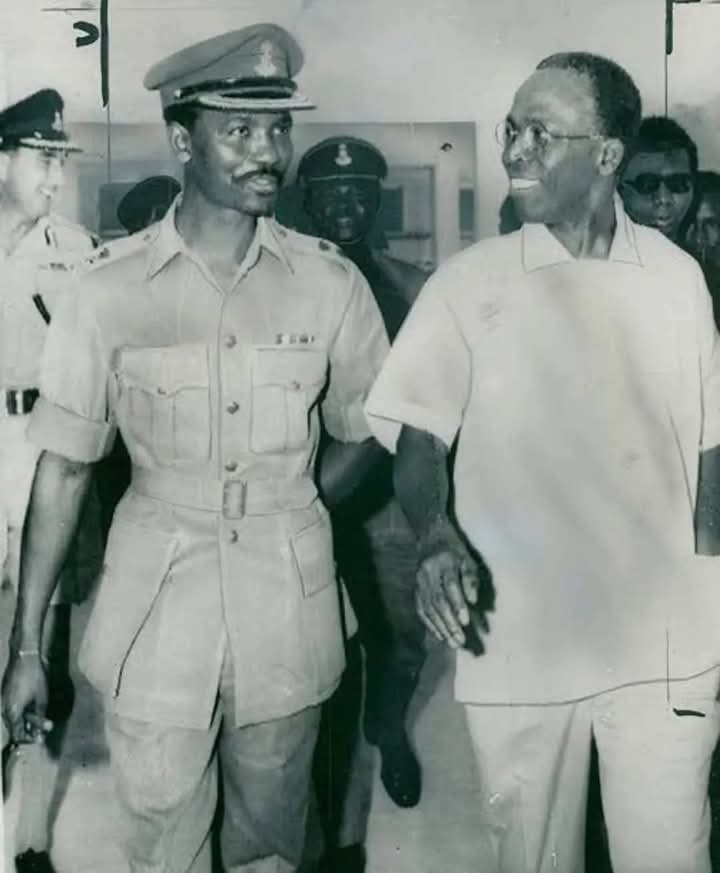
The Release of Chief Obafemi Awolowo: A foremost leader of the Action Group and the first Premier of the Western Region, was a central figure in Nigeria’s independence movement and post-independence politics.
A brilliant orator, lawyer, and strategist, Awolowo championed federalism, free primary education, and economic self-reliance.
However, in 1962, a political crisis erupted in the Western Region, leading to a split in the Action Group and a subsequent declaration of a state of emergency.
In 1963, Awolowo and several of his associates were arrested, tried, and convicted for allegedly plotting to overthrow the federal government. He was sentenced to 10 years in prison, a conviction many of his supporters believed was politically motivated.
The 1966 Coup and National Crisis
By 1966, Nigeria was in the grip of severe political instability. The first military coup in January 1966 overthrew the civilian government, leading to the installation of Major General Johnson Aguiyi-Ironsi.
However, ethnic tensions escalated, culminating in a counter-coup in July 1966 led by northern military officers, which brought Lt. Col. Yakubu Gowon to power as Head of State.
The country teetered on the edge of collapse, with secessionist tensions rising in the Eastern Region and fears of civil war mounting. In this volatile context, Gowon recognized the need to reconcile with key political figures who could help stabilize the nation.
Awolowo’s Release
On August 2, 1966, Lt. Col. Gowon ordered the release of Chief Obafemi Awolowo from the Calabar prison where he had been serving his sentence. The move was strategic and symbolic. It was widely seen as an attempt to bring respected statesmen back into the fold of national leadership to help guide the country through its crisis.
Awolowo’s release was welcomed across the country, particularly in the Western Region, where he was regarded as a hero. His return to the political scene rejuvenated hopes for national unity and democratic governance.
Aftermath and Role in the Civil War
Following his release, Awolowo was appointed as the Federal Commissioner for Finance and Vice Chairman of the Federal Executive Council under the military government. In this role, he played a critical part in shaping the economic policies that sustained the federal government during the Nigerian Civil War (1967–1970). His insistence on fiscal discipline and refusal to allow the printing of money to fund the war effort were key to maintaining economic stability.
Moreover, Awolowo was a strong advocate for keeping Nigeria united, though he remained firm in his belief in regional autonomy within a federal structure.
Legacy of the Event
The release of Obafemi Awolowo in 1966 remains a landmark moment in Nigerian history. It demonstrated the power of political reconciliation in times of national crisis and underscored the enduring influence of Awolowo in Nigerian affairs.
His post-release contributions to governance and nation-building reaffirmed his place as one of the founding fathers of modern Nigeria.
Today, the image of Awolowo standing with Yakubu Gowon on that historic day serves as a powerful symbol of redemption, leadership, and the pursuit of unity in a divided nation.